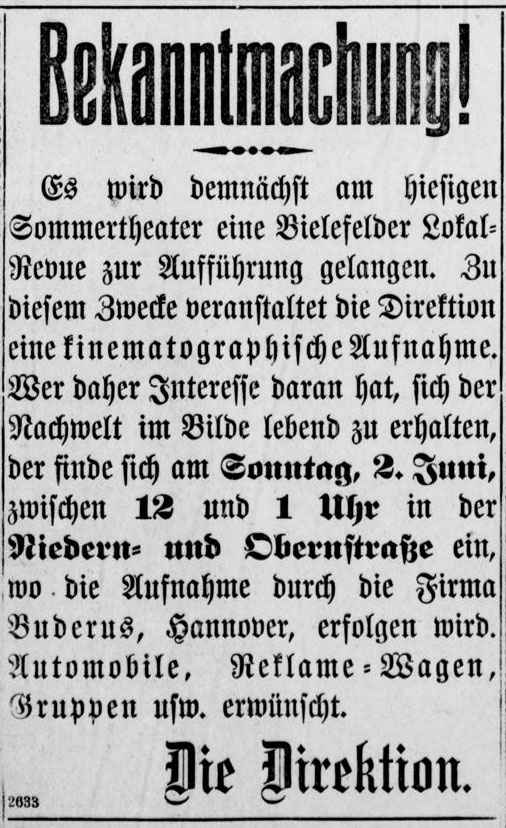
This advertisement was published on May 29, 1907, in the regional newspaper Volkswacht, which was distributed in Bielefeld and the surrounding area.
Bekanntmachung!
Es wird demnächst am hiesigen Sommertheater eine Bielefelder Lokal-Revue zur Aufführung gelangen. Zu diesem Zwecke veranstaltet die Direktion eine kinematographische Aufnahme. Wer daher Interesse daran hat, sich der Nachwelt im Bilde lebend zu erhalten, der finde sich am Sonntag, 2. Juni, zwischen 12 und 1 Uhr in der Niedern- und Obernstraße ein, wo die Aufnahme durch die Firma Buderus, Hannover, erfolgen wird. Automobile, Reklame=Wagen, Gruppen usw. erwünscht.
Die Direktion.1
As stated in the advertisement, the Bielefeld-based Sommertheater intended to present a revue focusing on the city. As part of the revue, and as a special attraction, a film was to be recorded in the city centre (the locations specified were Niedernstraße and Obernstraße). According to the advertisement, anyone interested in appearing in the film was welcome to join the production on the specified date. The appearance of automobiles, groups, and advertising vehicles was particularly encouraged.
This advertisement served two purposes: first, to attract people to participate in a moving-picture recording – an unusual experience in Bielefeld at the time. Secondly, it offered them the opportunity to experience the event again by seeing themselves on screen. Underlining the importance and intended reach of the project, similar advertisements with identical wording were published simultaneously in other local newspapers, such as Bielefelder General-Anzeiger2 and Westfälische Zeitung 3. This appeal by the Sommertheater was repeated daily in the same newspaper until the day before the recording 4.
An article published in the Westfälische Zeitung one day after the recording sheds some light on how the recording by Buderus was carried out.5 The cameraman used a tram as a platform for his camera, making use of the tram’s movement to introduce dynamism into the recording. The movement was not as smooth as presumably intended, as the streets were quite crowded and the tram could not always pass through, particularly due to a local orchestra performing along the route.
The development and delivery of the film took approximately two and a half weeks, as the film was advertised on June 19 for its first screening the following day.6 The following scenes were to be shown:
- Bild: Im Bielefelder Olymp.
- Bild: Die Reise nach dem Lutter-Strand (kinematographische Reise).
- Bild: Auf dem Schillerplatz.
- Bild: Im Apollo-Theater.
- Bild: Quer durch Bielefeld (kinematographische Reise).
- Bild: Hurra! Der Kaiser kommt! In Szene gesetzt von Direktor Sandhage. Musikalische Leitung Ernst Goldner.
Of these six scenes, two appear to be of a cinematographic nature (kinematographische Reise), while the description refers to the recording by engineer Carl Budérus as Bielefelder Straßenleben. Whether only parts of the recording were used in the revue, or whether some of the material was sourced elsewhere, cannot be established. This might explain the discrepancy between the descriptions of the individual scenes (Bild) and the title given to the recording.
A review was published one day after the premiere.7 The revue as a whole was very well received, although criticism was directed at at least one of the cinematographic scenes.
Vielleicht gewinnt das Stück, wenn die kinematographische Reise vom Himmel nach dem Schillerplatz fortfällt; mindestens aber muß die Bielefelder Stadttheaterszene gestrichen werden, des guten Geschmacks wegen.
In total, the revue was performed 25 times over a period of six weeks.8
Interestingly, a competitor by the name of Apollo-Theater began advertising cinematographic images made by Buderus as part of its theatrical programme, starting July 1 – the day of the recording in Bielefeld.9 This is noteworthy because the name Buderus had already been mentioned in the original advertisement by the Sommertheater, whereas the Apollo-Theater only began advertising the cinematographic images after the recording. Whether this was an attempt to imitate the competitor or not, the company Buderus was clearly well received in Bielefeld that summer.
thoughts
This local film made by Buderus in Bielefeld is striking for two reasons: First, it provides an early example of the interplay between theatre (live performance) and film (recorded images). Secondly, it illustrates how a local film recording accompanied by a media campaign could develop into a public event of sorts.
Interestingly, the approach of recording local events and subsequently presenting the resulting film to an audience was later adopted by cinemas in Bielefeld as well.10
copyright
The image used in this article is taken from:
- zeit.punktNRW The images used are in the public domain, as stated by the provider zeit.punktNRW.
sources
The newspapers can be accessed on the zeit.punktNRW.
-
Die Direktion. (1907, May 29). Volkswacht, No. 122(18),p. 6. Retrieved from: https://zeitpunkt.nrw/ulbms/periodical/zoom/4661119 ↩︎
-
Anonym. (1907, May 29). Bielefelder General-Anzeiger, No. 123(8), p. 5. Retrieved from: https://zeitpunkt.nrw/ulbms/periodical/zoom/4919157 ↩︎
-
Die Direktion. (1907, May 29) Westfälische Zeitung, No. 123(97), p. 10. Retrieved from: https://zeitpunkt.nrw/ulbms/periodical/zoom/1969439 ↩︎
-
Die Direktion. (1907, May 30). Volkswacht, No. 123(18),p. 8. Retrieved from: https://zeitpunkt.nrw/ulbms/periodical/zoom/4661129; Die Direktion. (1907, May 31). Volkswacht, No. 124(18),p. 9. Retrieved from: https://zeitpunkt.nrw/ulbms/periodical/zoom/4661138; Die Direktion. (1907, June 1). Volkswacht, No. 125(18),p. 6. Retrieved from: https://zeitpunkt.nrw/ulbms/periodical/zoom/4661151 ↩︎
-
Die Niedern- und Obernstraße. (1907, June 3). Westfälische Zeitung, No. 127(97), p. 3. Retrieved from: https://zeitpunkt.nrw/ulbms/periodical/zoom/1969490 ↩︎
-
Sommer-Theater. (1907, June 19). Bielefelder General-Anzeiger, No. 141(8), p. 6. Retrieved from: https://zeitpunkt.nrw/ulbms/periodical/zoom/4919364 ↩︎
-
Kunst und Wissenschaft. (1907, June 21). Volkswacht, No. 142(18),p. 3. Retrieved from: https://zeitpunkt.nrw/ulbms/periodical/zoom/4661288 ↩︎
-
Sommertheater. (1907, August 10). Volkswacht, No. 185(18),p. 6. Retrieved from: https://zeitpunkt.nrw/ulbms/periodical/zoom/4661665 ↩︎
-
Apollo-Theater. (1907, June 1). Bielefelder General-Anzeiger, No. 126(8), p. 7. Retrieved from: https://zeitpunkt.nrw/ulbms/periodical/zoom/4919187 ↩︎
-
Kinematographische Aufnahmen. (1907, August 31). Westfälische Zeitung, No. 204(97), p. 2. Retrieved from: https://zeitpunkt.nrw/ulbms/periodical/zoom/1970355 ↩︎